



When selecting spectator seating for sporting venues, schools, councils, and community facilities, durability, safety, and long-term value are critical considerations. Traditionally, steel and timber grandstands have been widely used, but modern venues are increasingly choosing aluminium grandstands — and for good reason.
Having a 20 Warranty and a 50+ year lifecycle, aluminium consistently delivers a lower total cost of ownership, making it a financially sound investment for councils, schools, and sporting organisations. Aluminium is also 100% recyclable at end of life.
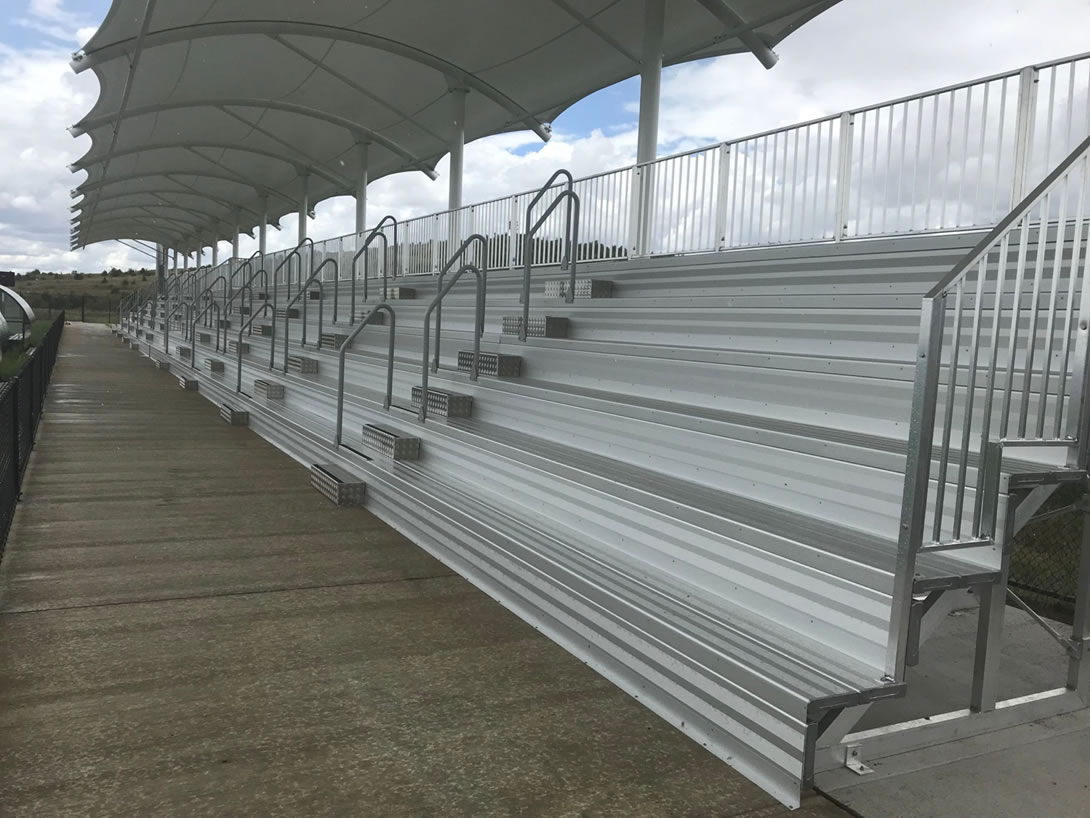
Aluminium grandstands offer a unique combination of strength, longevity, sustainability, and design flexibility that outperforms steel and timber alternatives in most applications.
- Superior Corrosion Resistance
One of the most significant advantages of aluminium over steel is its natural resistance to corrosion. Aluminium does not rust. Instead, it forms a protective oxide layer that shields it from further degradation.
- Ideal for coastal environments, aquatic centres, and outdoor sporting venues
- No need for constant repainting or anti-corrosion treatments
- Maintains structural integrity and appearance for decades
Steel grandstands, even when galvanised or painted, are prone to corrosion over time — particularly in high-moisture or salt-air environments — leading to higher maintenance costs and potential safety concerns.
- Lower Maintenance Costs Over the Life of the Grandstand
Timber grandstands require ongoing sealing, staining, and replacement of deteriorated boards. Steel structures often need repainting, rust treatment, and structural inspections.
Aluminium grandstands, by comparison, are low maintenance by design:
- No rotting, warping, or splintering
- No rust or flaking coatings
- Minimal long-term upkeep
Over a 20–30-year lifecycle, aluminium consistently delivers a lower total cost of ownership, making it a financially sound investment for councils, schools, and sporting organisations.
- Lightweight Without Compromising Strength
Aluminium is significantly lighter than steel, yet engineered aluminium grandstands provide exceptional strength and load-bearing performance.
This lightweight nature offers several advantages:
- Easier transport and installation
- Reduced foundation requirements
- Faster on-site assembly
- Ideal for modular and relocatable grandstands
For venues that require flexible seating configurations or future expansion, aluminium provides unmatched versatility.
- Compliance with Australian Building Standards
Modern aluminium grandstands are engineered to meet or exceed the Australian Building Code (NCC) and relevant Australian Standards, including:
- Structural loading
- Safety rails and balustrades
- Non-slip treads
- Vision-impaired stair nosing’s
- Safe ingress and egress
When designed and manufactured correctly, aluminium grandstands deliver the same — and often higher — safety performance than steel or timber alternatives.
- Environmentally Sustainable Choice
Aluminium is one of the most sustainable building materials available:
- 100% recyclable without loss of quality
- Long lifespan reduces replacement waste
- Lower lifecycle environmental impact
Many aluminium grandstands are now manufactured using low-carbon aluminium, helping councils and organisations meet sustainability and ESG objectives.
Timber grandstands, while often perceived as “natural,” frequently involve treated woods, shorter lifespans, and repeated material replacement.
- Modern Aesthetics and Design Flexibility
Aluminium grandstands offer a clean, modern appearance that suits contemporary sporting venues and public spaces.
Design advantages include:
- Custom lengths, tiers, and seating layouts
- Powder-coated or anodised finishes
- Seamless integration with existing facilities
- Professional, uniform presentation
This makes aluminium particularly popular for venues seeking a high-quality, long-term visual solution rather than a temporary structure.
Over a 20–30-year lifecycle, aluminium consistently delivers a lower total cost of ownership, making it a financially sound investment for councils, schools, and sporting organisations.
Conclusion
When comparing aluminium, steel, and timber grandstands, aluminium consistently delivers superior performance in durability, maintenance, sustainability, and long-term value.
For Australian venues looking for a safe, compliant, and future-proof seating solution, aluminium grandstands represent the smart, modern choice.